

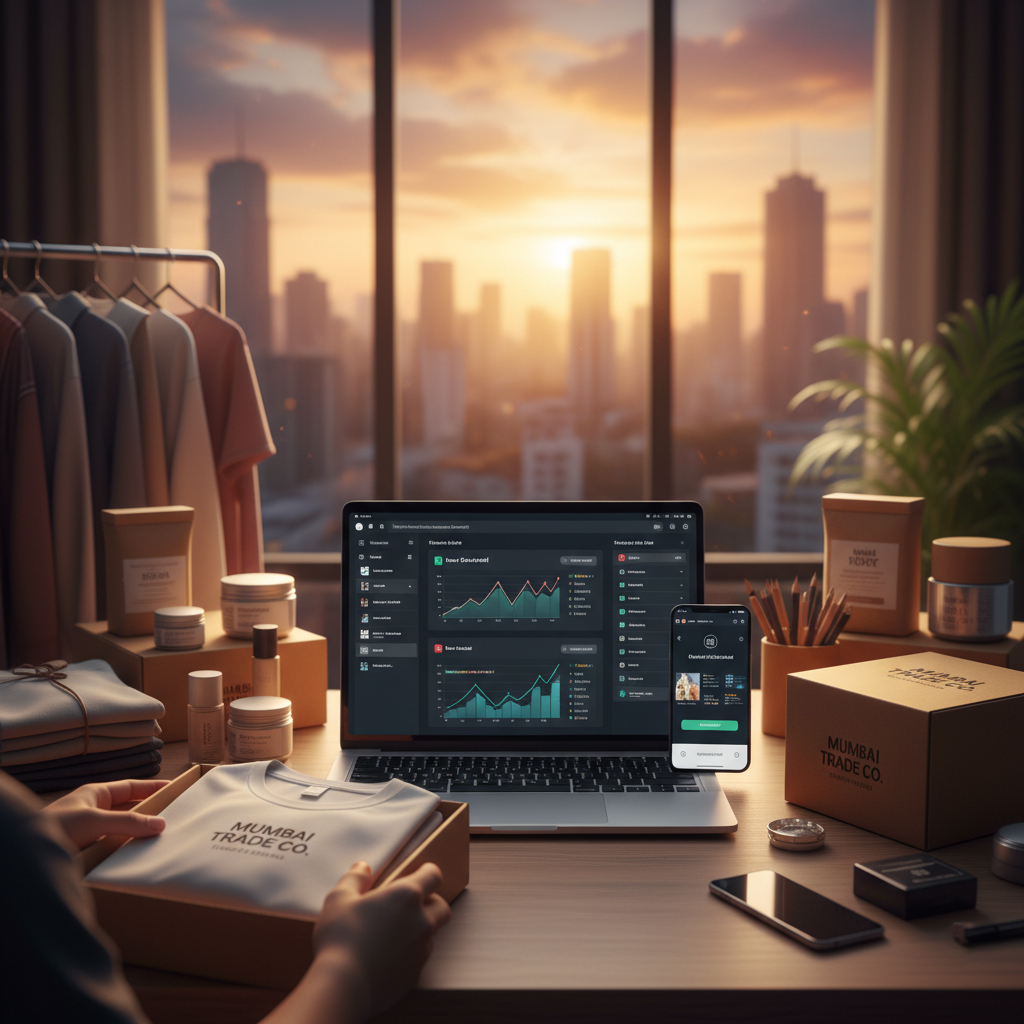

We create high converting websites tailored for your brand success

Search Now!
Contact Info
Location 1403/1404 Gold Crest Business Centre, opposite Manubhai Jewelers, Lokmanya Tilak Rd, Borivali West, Mumbai, Maharashtra
Contact Info
Location 1403/1404 Gold Crest Business Centre, opposite Manubhai Jewelers, Lokmanya Tilak Rd, Borivali West, Mumbai, Maharashtra

The Mumbai Ecommerce Opportunity Is Real — and Still Largely Untapped

India's ecommerce market is one of the fastest-growing in the world. Mumbai, as the country's commercial capital, sits at the centre of that growth. But what the headline numbers obscure is how unevenly that growth is distributed. The businesses capturing it are those that invested early in a proper digital commerce infrastructure. The majority of Mumbai businesses that could be selling online are either not selling online at all, or selling through marketplace platforms at margins that leave little room to build a sustainable brand.

The marketplace model — selling on Amazon, Flipkart, Myntra, Nykaa, Meesho — has real value as a distribution channel. It provides access to an existing customer base and eliminates the need to generate your own traffic from scratch. But it comes at a cost that goes beyond the commission percentage. Marketplace sellers have limited ability to build a brand relationship with their customers. They cannot control the shopping experience beyond the product listing itself. They are one algorithm change away from losing their ranking. And they are permanently exposed to the risk of the marketplace launching its own competing product in their category — which Amazon, Flipkart, and others have done repeatedly.

A branded direct-to-consumer ecommerce store does not replace marketplace presence for most businesses — it complements it. It is where the brand story lives. It is where repeat customers come back, bypassing the marketplace commission entirely. It is where you control the data on who your customers are and what they buy. And when built and marketed properly, it is where your best margins come from.

Building that store properly is not a small project. But it is one of the highest-ROI investments a Mumbai consumer brand can make — when it is done right.

Choosing the Right Platform — What We Recommend and Why

The most important decision in any ecommerce project is the platform. Get this wrong and you spend the next three years fighting the limitations of the wrong tool. Get it right and the platform becomes an asset that grows with your business.

At The Web Decor, we work across the full range of ecommerce platforms — Shopify, WooCommerce on WordPress, and custom PHP-based ecommerce solutions. Our recommendation in every project is based on the specific business: its product range, its order volume, its team's technical capability, its budget, and its growth trajectory. We do not default to the platform that is most profitable for us to build on. We recommend what is genuinely right for the business.

Shopify Development in Mumbai

Shopify is the platform of choice for most D2C brands in Mumbai and for good reason. It is a fully managed ecommerce platform — Shopify handles the hosting, security, software updates, and core payment processing infrastructure, which means your team does not need to manage any of that. The admin interface is genuinely usable by non-technical people. The app ecosystem is vast. And Shopify's performance infrastructure is reliable at scale in ways that self-hosted solutions sometimes are not.

For a Mumbai-based brand selling fashion, beauty, health products, home decor, or any category where the customer experience, the visual presentation, and the brand story are central to conversion — Shopify is usually the right platform.

The caveat is that Shopify done poorly is a wasted investment. A Shopify store built from an unmodified free theme, with default checkout flow, no speed optimisation, no proper SEO configuration, and stock product images will not convert. Shopify provides the infrastructure. The conversion performance comes from the custom design, the content strategy, the technical configuration, and the ongoing marketing — all of which are the work of the team building it, not the platform itself.

Our Shopify builds at The Web Decor are custom. We do not install a theme and hand it over. We design the store specifically for your brand and your customers — custom section layouts, Liquid template development for functionality the theme does not natively support, custom checkout flow optimisation, integration with Razorpay, Cashfree, and PayU for Indian payment processing, Shiprocket and Delhivery for logistics, and whatever marketing tools your team uses. The result is a Shopify store that looks and functions like it was built for your brand specifically, because it was.

Read More

WooCommerce Development in Mumbai

WooCommerce, the ecommerce extension for WordPress, is the right choice for businesses that want more flexibility than Shopify's architecture allows and are prepared to manage a self-hosted platform. It is particularly well-suited for businesses that need non-standard product structures — highly configurable products, subscription models, B2B pricing tiers, or any product that does not fit cleanly into the standard variant architecture that Shopify handles natively.

WooCommerce also makes sense for businesses that already have a WordPress website and want to add ecommerce functionality without migrating platforms, and for businesses where the content marketing side of the operation — an active blog, educational resources, long-form category content — is as important as the store itself.

The tradeoff with WooCommerce is maintenance complexity. Unlike Shopify, a WooCommerce store is self-hosted, which means plugin updates, server maintenance, security monitoring, and database management are the responsibility of the site owner and their agency. We build WooCommerce stores with this ongoing maintenance reality in mind — lean plugin stacks, a well-configured hosting environment, and clear documentation and support arrangements that mean the store does not become a liability six months after launch.

Read More

Custom PHP Ecommerce Development

For businesses with requirements that neither Shopify nor WooCommerce can accommodate cleanly — B2B portals with complex pricing logic, multi-vendor marketplaces, industry-specific ordering systems, or large-scale platforms with unique data architecture requirements — a custom PHP ecommerce solution is the right call.

Custom builds are more expensive, take longer, and require a more thorough specification process before development begins. They are also the only option when the business logic is genuinely unique. We have built custom ecommerce applications for manufacturers with complex B2B ordering requirements, for food businesses with time-sensitive perishable ordering constraints, and for service businesses that needed a booking-plus-payment architecture that no off-the-shelf platform could provide cleanly.

If you are considering a custom ecommerce build, the first conversation is always about requirements. What exactly does the platform need to do that a standard solution cannot? From that conversation, we can tell you whether a custom build is genuinely necessary or whether a well-configured standard platform can achieve what you need for significantly less investment.

Read More

What Actually Makes an Ecommerce Store Convert

This is the question that matters more than any platform decision, and it is the one that most ecommerce agencies in Mumbai do not have a systematic answer for.

Conversion in ecommerce is not one thing. It is the cumulative result of dozens of decisions made throughout the design and development process. A store that is missing any of the following elements is underperforming regardless of how good the platform is or how much money is being spent on ads to drive traffic to it.

1.

Product Pages That Do the Work of a Salesperson

The product page is where the conversion happens or does not happen. A product page that has the product name, a price, a single image, and an Add to Cart button is not a product page — it is a product listing. A product page that converts has multiple images showing the product from different angles, at different scales, in context of use. It has a description that answers the questions a customer would ask a salesperson — what is it made of, how does it fit or work, what should I know before I buy, what are the dimensions. It has clear information about shipping timelines, return policy, and what happens if the product is not right. It has social proof — reviews, ratings, or at minimum some indication that other customers have bought and been satisfied. And it has a clear, friction-free path to purchase.


We build product pages with all of these elements planned from the design stage, not retrofitted as an afterthought. The page structure is designed to answer customer questions and remove purchase barriers progressively as the customer scrolls, with the Add to Cart action always within reach.

2.

Mobile Commerce — Not Just Mobile-Friendly

The majority of ecommerce traffic in Mumbai arrives on mobile devices. This is not a design consideration to be addressed after the desktop experience is designed — it is the primary design context. A store that is "mobile-friendly" — meaning the desktop design has been made to squeeze onto a phone screen — is fundamentally different from a store that was designed for mobile first, where every interaction, every touch target, every content priority was decided with a thumb on a screen in mind.


The difference in conversion rates between these two approaches is significant and measurable. We design mobile-first. Every store we build is tested on actual iOS and Android devices — not just in a browser emulator — before it launches.

3.

Checkout Flow — Where Most Ecommerce Sales Are Lost

Cart abandonment is the most expensive problem in ecommerce. Industry research consistently shows that the majority of customers who add a product to cart do not complete the purchase. The primary drivers of abandonment at the checkout stage are: unexpected costs revealed at checkout; a checkout process that requires too many steps or too much information; a payment process that does not support the customer's preferred payment method; and a lack of trust signals at the moment of payment.


We optimise checkout flow in every store we build. This means configuring guest checkout so customers are not required to create an account before buying, displaying shipping costs clearly before checkout begins, reducing form fields to the minimum necessary, and presenting trust signals — security badges, clear return policy, payment method logos — at the point of purchase.

4.

Page Speed — the Conversion Factor Nobody Talks About Enough

Ecommerce stores are heavier than brochure websites. Product images, multiple scripts from marketing tools and app integrations, video content, and review widgets all add weight to the page. Unmanaged, this weight translates into slow loading times that kill conversion. Research from Google consistently shows that conversion rates drop measurably with each additional second of mobile loading time.


We address page speed throughout development rather than at the end as a remediation exercise. Image optimisation and modern formats, lazy loading, script management, caching configuration, and CDN delivery are all part of the standard build process. Every store we launch is tested against Core Web Vitals benchmarks and is configured to load in under two seconds on a standard mobile connection.

5.

The Indian Payment Ecosystem — Getting It Right

The Indian payment ecosystem — UPI, net banking, EMI on debit and credit cards, wallets, and the specific bank integrations that Indian customers rely on — requires configuration that goes beyond installing a standard payment plugin.

We integrate Razorpay, Cashfree, PayU, or CCAvenue depending on the client's needs and the platform, and we configure the full range of Indian payment methods including UPI, all major card networks, net banking, and EMI options. We test every payment path thoroughly before launch — not just the success path, but the failure and timeout paths as well, because an Indian customer who encounters a payment error that is not handled gracefully is a lost customer.

The SEO Foundation — Why It Has to Be Built In, Not Added Later

A new ecommerce store with no SEO foundation gets no organic traffic. This is not a controversial observation — it is just how search engines work. A new store is invisible to Google until Google has crawled it, understood its structure, and begun to evaluate its relevance and authority for specific search queries. This process takes time, and the speed at which it happens depends heavily on how well the site is built from an SEO perspective.

The URL and category architecture of the store — how products are categorised, how URLs are structured, how internal links connect product pages to category pages to the homepage — is one of the most important SEO decisions in an ecommerce project, and it needs to be made before development begins, not retrofitted after launch. A category structure that was designed for internal organisation rather than search engine clarity is one of the most common and most expensive ecommerce SEO mistakes.

Product page SEO — title tags that include the search terms customers actually use, meta descriptions that are genuinely informative and include a call to action, heading structure that follows logical hierarchy, image alt text that describes the product accurately — is built into our development template rather than left for the client to add manually after launch.

Technical SEO foundations — canonical URL configuration to prevent duplicate content issues (a common problem in ecommerce stores with product variants), XML sitemap generation and submission, robots.txt configuration, structured data markup for products which enables rich results in Google including price, availability, and review stars, and page speed optimisation — are all addressed as part of the standard build.

For clients who want to pursue active SEO campaigns after launch — category page content optimisation, blog content targeting commercial intent searches, link acquisition, and local SEO for stores with a physical retail presence — our SEO team handles this in-house, as part of the same engagement that builds the store.

Ecommerce Website Development in Mumbai

Ecommerce Photography — The Most Underestimated Conversion Factor

The fastest way to destroy conversion on an otherwise well-built ecommerce store is to populate it with poor product images.

This is the point where we are genuinely different from almost every other web development agency in Mumbai. We offer ecommerce product photography and model photography in-house, through our studio in Borivali. This is not a service we subcontract or coordinate separately — it is delivered by our team, aligned with the specific requirements of the store we are building.

The significance of this integration is practical and measurable. When the team shooting your product images and the team building your ecommerce store are the same team, the images are delivered in the exact formats, dimensions, and colour profiles required by the store and its target platforms. There is no coordination overhead, no mismatched specifications, no discovery at launch that the images need to be re-exported.

For brands selling on Amazon, Flipkart, Myntra, Nykaa, or any major Indian marketplace in addition to their own store, we shoot images to the specific technical requirements of each platform simultaneously. Amazon's main image requirements — white background, product filling a specific percentage of the frame, minimum 1000 pixels on the longest side — are different from Myntra's lifestyle image requirements and different from Nykaa's category-specific standards. We know all of these requirements and deliver accordingly.

Our product photography covers every category that Mumbai's ecommerce market produces: skincare and cosmetics, fashion and apparel, jewellery and accessories, home decor, food and beverage products, electronics accessories, health and wellness products, stationery, handcrafted and artisanal goods, and more. Our model photography covers fashion, apparel, jewellery, footwear, and lifestyle categories where the product needs to be seen on a real person to communicate fit, proportion, and styling in a way that drives purchase confidence.

For brands that are building an ecommerce store and need their visual content developed simultaneously, we offer a combined package that coordinates the store build and the photography as a single integrated project. The result is a store that launches with professional, platform-optimised imagery from day one.

Ecommerce in Mumbai — What We Know About Specific Categories

Ten years of ecommerce work in Mumbai has given us category-specific knowledge that shapes how we approach every project.

Fashion and Apparel

Fashion is one of the most competitive ecommerce categories in India and one where the gap between a store that converts and one that does not is particularly visible. The customer journey in fashion ecommerce is visually driven. The quality of the product photography, the accuracy of the size guide, the clarity of the return and exchange policy, and the range of payment options all directly affect conversion in ways that are more acute in fashion than in most other categories. We have built ecommerce stores for fashion brands across the spectrum — streetwear labels in Andheri, premium ethnic wear brands, activewear startups, corporate workwear brands, and sustainable fashion labels.

Beauty, Skincare, and Personal Care

Beauty ecommerce in India is growing faster than almost any other category. For beauty brands, the product page is where the difference is made or lost. Ingredient transparency, formulation claims handled in compliance with Bureau of Indian Standards regulations, and ingredient glossaries that help customers understand what they are buying — all of these elements require careful attention in a category where customer trust is the primary conversion barrier for new brands.

Food and Beverage

Food ecommerce is one of the most complex categories in terms of regulatory requirements, logistics constraints, and customer expectation management. FSSAI licensing and labelling requirements, cold chain logistics for perishable products, and nutritional information display requirements all need to be addressed in the store design and content. We have built ecommerce stores for Mumbai-based food brands — artisanal snacks, health foods, specialty ingredients, packaged ready-to-eat products, and beverages — and we understand the specific content and compliance requirements of this category.

Jewellery

Jewellery ecommerce has one of the highest average order values of any consumer category, which means the stakes around photography, trust signals, and customer experience are particularly high. A customer spending twenty thousand rupees on a piece of jewellery online needs to feel confident about the product, the seller, and the purchase process. We build jewellery ecommerce stores with this trust requirement at the centre of every design decision — metal purity and certification information prominently displayed, hallmark details clearly visible, return and exchange policies explained explicitly, and EMI options for higher-value purchases.

Home Decor and Lifestyle

Home decor ecommerce presents a specific conversion challenge: customers cannot experience the physical scale, texture, and material quality of a product from images alone. Overcoming this requires photography that is genuinely informative — context shots that show the product in a styled room environment at a recognisable scale, close-up texture shots, and accurate colour representation.
B2B and Industrial Products

Business-to-business ecommerce is one of the fastest-growing segments of Indian ecommerce, and Mumbai's substantial manufacturing and industrial base creates a significant opportunity for B2B sellers to build direct ordering platforms for their trade customers. B2B ecommerce architecture is different from consumer ecommerce — tiered pricing for different customer types, bulk order functionality, quote request workflows, GST invoice generation, and account management features for trade customers all need to be considered.

The Marketplace Integration Question

Most of our ecommerce clients are selling — or want to sell — through marketplace platforms in addition to their own store. This is a legitimate strategy that we support, but it requires a clear-eyed view of the relationship between the two channels.

The marketplace channel is a customer acquisition channel. It provides access to a platform's existing buyers, handles the customer relationship to a significant degree, and offers marketing tools within the platform. The trade-off is margin — the commission structure of most Indian marketplaces makes the economics of marketplace-only selling challenging, particularly in commodity or near-commodity categories.

The owned store channel is a brand equity and profitability channel. Customers who come to your own store are more likely to be repeat buyers, more likely to engage with your brand content, and more profitable per transaction because you are not paying marketplace commission. The challenge is that owned store traffic needs to be generated — through SEO, social media, email marketing, and paid advertising — rather than borrowed from the marketplace's existing audience.

We help clients think through this channel strategy as part of the ecommerce project, and we build stores that are designed to complement marketplace presence rather than duplicate it.

The Full Ecommerce Build Process at The Web Decor

Discovery and Strategy

Every ecommerce project begins with a thorough discovery session. We want to understand your products, your customers, your current sales channels, your team's technical capability, your logistics infrastructure, and your growth goals. We review your existing product range, your competitors' stores, and the search landscape for your category in the Indian market. From this discovery, we recommend the right platform, outline the category and URL architecture, map the customer journey from landing page to purchase completion, identify the integrations required, and document the project scope clearly before any design work begins.

Design

Ecommerce design is conversion design. Every element of the store layout — the homepage hero, the category navigation, the product grid, the product page layout, the cart and checkout flow — is designed with a specific conversion function in mind. We design all key page templates: homepage, category page, product page, collection page, cart, checkout, order confirmation, and any brand content pages. Design is presented for review and refined until it is right before development begins.

Development

Development implements the approved design across the selected platform with all required integrations configured and tested. For Shopify builds, this includes custom Liquid theme development, app installation and configuration, payment gateway integration, logistics platform integration, Google Analytics 4 and Meta Pixel implementation, and email marketing platform integration. We do not launch a store until every integration has been tested across its full range of scenarios — not just the clean success path but the payment failure path, the out-of-stock path, the address validation failure path, and any other edge case that real customers will encounter.

SEO Configuration

SEO configuration is a standard part of every ecommerce build — URL structure, meta tags, structured data, sitemap, robots.txt, Core Web Vitals — all configured before launch.

Photography Integration

For clients using our photography services, the product shoot is coordinated with the development timeline so that professional images are available for content population before the store launches. We do not go live with placeholder images.

Launch and Post-Launch

We manage the full technical launch process — domain connection, SSL configuration, payment gateway go-live verification, Google Search Console submission, and post-launch monitoring. We provide thirty days of post-launch support as standard, and we offer ongoing retainer arrangements for stores that want continued development, SEO growth, and technical maintenance.
Why Mumbai Ecommerce Brands Choose The Web Decor

There are dozens of web development agencies and freelancers in Mumbai who can build an ecommerce website. The question is not whether someone can build it — it is whether they can build it in a way that actually drives revenue.

We offer something no other web development agency in Mumbai offers: genuine in-house capability across website development, ecommerce build, SEO, branding, product photography, and model photography. These are not services we subcontract. They are delivered by the same team, in the same office, with full integration between every element.

For an ecommerce brand, this integration is not a convenience — it is a structural advantage. When the team building your store is the same team shooting your product images, the images arrive in the right format for the store. When the team doing your SEO is the same team that built the store, the technical architecture and the keyword strategy are aligned from the beginning. When the team managing your branding is the same team designing your store, the visual language is consistent from the logo to the checkout page.

This is the version of ecommerce development that actually produces stores that sell. And it is what we build for Mumbai businesses.

Frequently Asked Questions

Ecommerce website costs vary significantly depending on the platform, the number of products, the level of custom design and development, and the integrations required. A custom Shopify store for a fashion or beauty brand typically ranges from Rs 60,000 to Rs 2,50,000 depending on scope. A WooCommerce build with more complex requirements sits in a similar or slightly higher range. Custom PHP ecommerce applications start at Rs 2,00,000 and go significantly higher for complex builds. We quote every project individually after understanding the actual scope. Contact us for a free consultation.

A Shopify store with custom design and standard integrations typically takes four to six weeks from approved scope to launch. A WooCommerce build takes a similar timeline. Custom PHP applications typically take six to twelve weeks. These timelines assume the client is able to provide product content and feedback on a reasonable schedule. We confirm timelines at the start of every project and hold to them.

For most consumer D2C brands in Mumbai — fashion, beauty, food, home decor, lifestyle products — Shopify is the right choice. It handles hosting and security, has a reliable Indian payment ecosystem integration, and is genuinely easy for non-technical teams to use and update. WooCommerce is better suited for businesses that need more customisation flexibility, that have complex product structures, or that are already on WordPress and want to add ecommerce. We will recommend the right platform for your specific situation in the discovery call.

Yes. We integrate Razorpay, Cashfree, PayU, and CCAvenue depending on the platform and the client's needs. Every integration includes the full Indian payment ecosystem — UPI, net banking, all major card networks, debit card EMI, credit card EMI, and digital wallets. We test every payment path thoroughly before launch.

Yes — and this is one of the things that makes The Web Decor genuinely different from most ecommerce agencies in Mumbai. We offer ecommerce product photography and model photography in-house through our Borivali studio. We coordinate the photography and the website build as a single integrated project, which means your store launches with professional, platform-optimised images from day one. Contact us to discuss your photography requirements alongside the website project.

Not automatically — no new store does. But an ecommerce store built with proper SEO foundations is positioned to build organic rankings over time. For clients who want to actively accelerate that process with a content and link strategy, our SEO team handles ecommerce SEO in-house. The advantage of having the same team build the store and manage the SEO is that the technical and content decisions are aligned from the beginning.

The marketplace and your own store serve different strategic purposes and can coexist productively. Marketplace presence gives you access to existing buyers. Your own store gives you brand ownership, customer data, higher margins on repeat purchases, and independence from marketplace algorithm and policy changes. For brands that are serious about building a sustainable consumer brand rather than just a marketplace listing business, building a direct-to-consumer store is an important step — and one that pays off increasingly as the brand builds its own audience.

Yes. We offer SEO services, Google My Business management, social media marketing, content writing, and paid digital marketing — all in-house. For ecommerce clients who want a full-service arrangement covering the store build, the ongoing SEO, and the marketing strategy, we offer integrated retainer packages that manage all of it as a single coordinated programme.

Start Building Your Ecommerce Store in Mumbai

If you are a Mumbai-based business that is ready to sell online properly — not the fast and cheap version that creates more problems than it solves, but a store that is built to convert, built to rank, and built to grow — The Web Decor is ready to help.

The first step is a conversation. We understand your business, your products, your customers, and your goals. We recommend the right platform, outline the right approach, and give you a clear, itemised quote before any commitment is required.

Call or WhatsApp: +91 98348 31326 | +91 96642 81633 Email: info@thewebdecor.com Website: www.thewebdecor.com Offices: Borivali East and Dadar East, Mumbai