





Static Website Development in Mumbai - Built for Speed, Built for Business
Let's be honest about something most agencies won't say out loud.
A large number of businesses in Mumbai are spending anywhere between ₹20,000 and ₹1,50,000 on websites that look decent on the day they launch and then slowly turn into a liability. Slow loading times. Hacked once or twice a year. Plugins breaking every few months. Pages that look completely broken on a mobile screen. And the original developer? Unreachable.
We have heard this story more times than we can count. Clients come to us after these experiences - frustrated, sometimes significantly out of pocket - and the first thing they ask is: why did nobody explain this before we paid for it?
So let us explain it now.
If your business does not need a blog, does not sell products online, and does not require users to log in and manage accounts - then there is a very strong case that what you actually need is a static website. Not because it is the cheaper option. Not because it is simpler to build. But because for your specific use case, it will genuinely outperform a dynamic website on almost every metric that matters: loading speed, security, reliability, and search engine performance.
This is what The Web Decor specialises in. We build static websites for Mumbai businesses - businesses that want a professional digital presence, not a maintenance headache.
What Exactly Is a Static Website? Let's Clear the Confusion
The word "static" throws people off. It sounds like it means boring, or outdated, or limited. It doesn't mean any of those things.
A static website is simply a website where the pages are pre-built and served directly to the visitor, exactly as they are. When someone lands on your homepage, your browser receives an HTML file, a CSS file, maybe a JavaScript file - and it displays them. That's it. Clean, direct, no middleman.
A dynamic website works differently. Every time a visitor lands on a page, the server runs a script, queries a database, pulls together the content, builds the page on the fly, and then serves it. This happens in milliseconds - but it still happens. And it adds overhead. It adds complexity. It adds points of failure.
For a website where the content doesn't change fifteen times a day - a business website, a professional portfolio, a service page, a restaurant menu - this entire process is unnecessary. You are running a complex machine to do a simple job.
Static websites skip all of that. And the benefits are not small or marginal. They are significant and measurable.
The Speed Difference Is Real - and It Affects Your Rankings
Google has been very clear about page speed as a ranking factor for years now. With the introduction of Core Web Vitals - Largest Contentful Paint, First Input Delay, Cumulative Layout Shift - they formalised it even further. A website that loads slowly gets penalised in rankings. Not catastrophically, not overnight - but steadily, and in a competitive market like Mumbai, steadily is enough to matter.
Static websites consistently score better on Core Web Vitals than equivalent dynamic websites. The reasons are structural: there is no server-side processing, no database queries, no plugin overhead. The files are typically smaller, the delivery is cleaner, and CDN caching works far more efficiently for static files than for dynamically generated content.
We regularly test websites before and after rebuilding them as static sites. The results are not subtle. A website that was taking 4.2 seconds to load on mobile starts loading in under 1.5 seconds. That is not a technical improvement that only developers notice - that is a difference your potential customers feel every single time they tap on your link.
And in Mumbai, where a significant portion of web traffic happens on 4G connections with varying signal strength, that speed difference is even more pronounced.
Security - The Problem That Nobody Talks About Until It's Too Late
Here is something that does not get discussed enough in the conversations businesses have with web agencies: WordPress websites get hacked constantly. Not sometimes. Constantly.
There are automated bots crawling the internet every hour of every day, probing websites for known vulnerabilities - outdated plugins, default admin URLs, weak passwords, unpatched CMS versions. The numbers from cybersecurity research are staggering: tens of millions of WordPress sites are attacked every day. Most of the time, a decent security setup blocks these attempts. But it only takes one successful attempt.
Static websites don't have this problem. There is no database to inject malicious code into. There is no admin panel to brute-force. There is no plugin ecosystem with known CVEs that bots can exploit. The attack surface simply doesn't exist.
For a Mumbai business owner - especially one running a professional services firm, a medical practice, or any business where website credibility is closely tied to client trust - having a site that gets defaced or goes down because of a hack is genuinely damaging. It is not just inconvenient. It affects your reputation.
A static website eliminates this risk almost entirely.
Maintenance: The Hidden Cost That Adds Up Over Time
When you are comparing website quotes, the number on the proposal is almost never the full cost of the website over its lifetime. With a dynamic website, you need to account for regular maintenance: CMS updates, plugin updates, theme updates, security patches, database optimisations, backup management. Every update has a non-zero chance of breaking something. And when something breaks at 11pm on a Tuesday, you are either fixing it yourself or calling your developer and hoping they pick up.
A static website, once deployed, essentially runs itself. There is no CMS to update, no plugins to patch, no database to optimise. The hosting costs are typically lower too - static files can be served from CDN infrastructure at very low cost, whereas dynamic sites require active server compute.
Over three to five years, the total cost of ownership of a well-built static website is considerably lower than an equivalent dynamic website. For small and medium businesses in Mumbai - where every rupee of overhead matters - this is not a trivial consideration.
Who Should Get a Static Website? Be Honest With Yourself
Before we go further, let us be clear about where static websites make sense and where they don't. We are not trying to sell you something that isn't right for your business.
A static website is an excellent choice if you are a professional - a doctor, dentist, lawyer, chartered accountant, architect, interior designer, consultant - who needs a clean, credible website that tells people who you are, what you do, and how to reach you. You do not need a blog that you will post on twice and then abandon. You do not need an ecommerce catalogue. You need a website that makes a strong impression and gives people a reason to call.
It is an excellent choice if you run a restaurant, a cafe, a salon, a gym, or any physical business where the website's job is to show the place, share the menu or services, give directions, and capture bookings or enquiries. A static website does all of this better, faster, and more reliably than a WordPress site with seventeen plugins.
It is an excellent choice for startups and new businesses that need to launch a credible digital presence quickly, without overcomplicating things before they have validated their business model. Build a great static site, get it in front of people, learn from the response, and iterate later when you know more about what your customers actually need from your website.
It is an excellent choice for portfolios, campaign microsites, event pages, coming-soon pages, and any web presence that is built around presentation rather than interaction.
Where static websites are not the right call: large ecommerce stores that need inventory management, product variants, cart functionality, and payment gateways. Websites with active blogs that are updated multiple times a week. Platforms that require user accounts, personalised content, or complex data management. For these use cases, we build dynamic websites - and we are equally good at that. But we will always tell you which one makes more sense for your specific situation, even if the dynamic build is the more expensive option.
What The Web Decor Actually Builds - Not the Generic Agency Version
Let us talk about what makes a static website genuinely good versus merely functional. Because there is a significant difference, and most agencies do not explain it.

Design That Fits the Business - Not the Template
Every static website we build starts with a blank canvas. We do not browse Envato Market for a ₹2,000 theme that is close enough. We design your website from scratch - layouts, typography, colour choices, image treatment, whitespace - all of it decided based on what your specific business needs to communicate to your specific audience.
This matters more than most business owners realise. A chartered accountancy firm in Nariman Point and a streetwear brand in Andheri both need websites - but they need completely different websites. The design choices that make one work would make the other look wrong. When you build from a template, you are always fighting the original design intent. When you build from scratch, everything fits.

Copy That Actually Does Work
Design without copy is decoration. The words on your website are doing most of the actual business work - communicating your value proposition, addressing your visitors' concerns, building trust, and guiding them toward the action you want them to take.
We work with clients on their copy throughout the project. If you already have content, we help shape it into something that reads well, communicates clearly, and is structured for both human readers and search engines. If you need help writing content from scratch, we can do that too. Either way, the words on your website get the same attention as the visuals.

Code That Is Actually Clean
This one matters more than most clients know about. Clean, semantic HTML is not just good practice - it directly impacts SEO performance. Search engines read your code. If your HTML is a bloated mess of div-soup, inline styles, and meaningless class names, it makes the crawler's job harder. If it is well-structured, uses proper semantic elements (header, nav, main, article, footer), and has a logical heading hierarchy, it tells the search engine exactly what the page is about and how it is organised.
Every website we build uses modern, semantic HTML5 and CSS3. Our code is written by hand, not generated by visual drag-and-drop editors. It is clean, readable, maintainable, and optimised for performance from the first commit.

Performance Engineering - Not an Afterthought
Speed does not happen by accident. It is the result of deliberate choices made throughout the development process: image compression and modern formats, lazy loading, minified CSS and JavaScript, efficient font loading, proper cache headers, CDN configuration. Each of these is a separate decision that either gets made consciously or gets ignored.
We make all of them consciously. When your website launches, it is not fast by luck. It is fast because we built it to be.

On-Page SEO Baked In From Day One
SEO is not something you add to a website after it's built. By that point, a lot of the most important decisions - URL structure, page hierarchy, heading structure, internal linking architecture - have already been made. If they were made badly, fixing them later is painful and sometimes not fully possible.
We build SEO into the foundation. Before we write a line of code, we look at the keyword landscape for your business. We look at what your competitors are ranking for, what search volumes look like for relevant terms, and where the realistic opportunities are. This informs the page structure of the website - how many pages there are, what they are called, how they link to each other, and what content appears on each one.
By the time your website launches, it already has properly structured title tags and meta descriptions, a logical heading hierarchy starting with one clear H1 per page, descriptive alt text on every image, canonical URL configuration, an XML sitemap submitted to Google Search Console, and proper robots.txt configuration. None of this is optional. All of it is standard.

The Full Process - From First Call to Launch Day
There is a version of website development that goes like this: client sends some notes, agency disappears for a month, a website appears, client asks for changes, agency charges extra for every change, website launches looking slightly different from what was agreed. We have heard this story too many times.
Our process is different. Here is how it actually works.
The first conversation
Is exactly that - a conversation. Not a sales call. We want to understand your business, your customers, your competitors, your current digital situation, and your goals. We will ask questions, and we will give you honest answers about what we think you need and what you do not. If we think your existing website just needs an update rather than a full rebuild, we will tell you that.
Proposal and scope
Comes next. We write a clear, specific proposal that describes exactly what we are going to build: how many pages, what functionality, what is included, what the timeline looks like, and what the cost is. No ambiguity. No room for misunderstandings later.
Wireframing
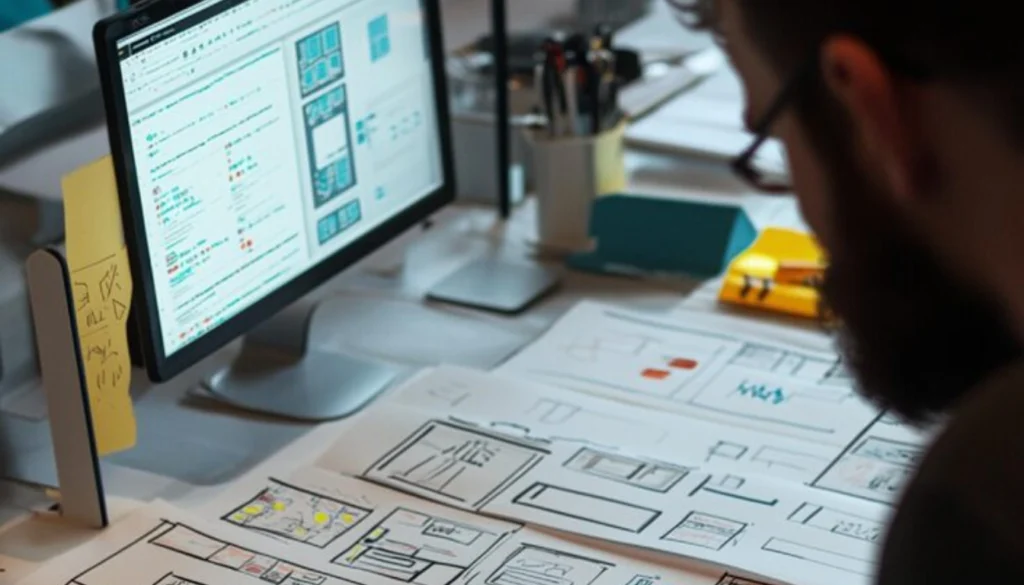
Is where we plan the structure of the website before any design work begins. We map out every page: what sections it contains, where the calls to action are, how the navigation works, and what the user journey looks like from landing to conversion. You approve the wireframes before we move forward.
Design
Is the most iterative part of the process. We create a full visual design for the key pages and share them with you for review. You give feedback. We refine. We go back and forth until the design is right - not until the revision rounds run out, but until it is actually right.
Development
Is where the design becomes a real website. Our developers translate the approved design into clean, semantic, responsive HTML, CSS, and JavaScript. This is also where all the performance optimisation work happens: image processing, code minification, caching configuration, and everything else that determines how fast the site actually loads.
Testing
Is thorough and non-negotiable. We test every page on every major browser. We test on actual mobile devices, not just browser emulators. We run speed tests and Core Web Vitals checks. We check every link, every form, every interactive element. Nothing goes live until it passes every check.
Launch
Is managed by us end to end. Domain connection, hosting setup, SSL configuration, Search Console submission - you do not need to manage any of it unless you want to. We hand you a live website, a brief on how everything is set up, and clear guidance on next steps.
Post-launch support
is real, not theoretical. For 30 days after launch, we are available to handle any issues, make small adjustments, and answer questions. After that, we offer ongoing support and maintenance packages for clients who want them.
Local Knowledge Matters - Here Is Why We Understand Mumbai
Mumbai is not a monolithic market. Businesses in Bandra operate in a very different environment from businesses in Ghatkopar. The customers who walk into a clinic in Borivali have different habits and expectations from the customers who book a consultant in Nariman Point. The competitive intensity of Andheri's commercial market is completely different from Thane's.
This sounds obvious when you say it out loud, but it has real implications for how a website should be designed and what it should say. The way you communicate your credibility to a Borivali MSME owner is different from how you communicate it to a corporate procurement team in BKC. The keywords that matter for a restaurant in Dadar are different from the keywords that matter for the same type of restaurant in Colaba.
We are based in Mumbai. Our office is in Borivali East. Our team lives and works in this city. We understand these differences not as abstract market research but as lived experience. And that understanding shapes the work we do.
Over the last decade, we have built websites for businesses across the full geography of Mumbai - Andheri, Bandra, Borivali, Kandivali, Malad, Goregaon, Dadar, Parel, Lower Parel, Worli, Ghatkopar, Kurla, Chembur, Thane, Navi Mumbai, and more. We have worked with medical practices, law firms, restaurants, manufacturers, educational institutes, creative agencies, retailers, and exporters. Every one of these projects has added to our understanding of what works in this city and what doesn't.
That is the difference between working with a Mumbai agency that actually knows Mumbai and working with a remote team that is guessing.
What You Get - Every Single Project, No Exceptions
We want to be specific about what is included in a static website project at The Web Decor, because vague promises of "great quality" and "full support" are meaningless without specifics.
Every project includes a completely custom design - no purchased themes, no template modifications. It includes full responsiveness across mobile, tablet, and desktop, tested on real devices. It includes SEO-ready page structure with optimised titles, meta descriptions, heading hierarchy, image alt tags, canonical URLs, XML sitemap, and robots.txt. It includes SSL certificate setup and HTTPS configuration. It includes a working contact form with email delivery. It includes Google Analytics 4 integration and Google Search Console setup. It includes cross-browser testing across Chrome, Firefox, Safari, and Edge. It includes Core Web Vitals optimisation targeting good scores across all three metrics. And it includes 30 days of post-launch support.
If you need copywriting, additional pages, logo design, photography, SEO campaign management, or Google My Business setup - all of these can be added to the project. We handle them in-house. There is no handoff to freelancers, no coordination overhead, no inconsistency.
Industries We Work With - And Why Each One Has Different Needs

Medical, Dental & Healthcare
A healthcare website carries a particular kind of responsibility. Patients making decisions about their health are looking for two things above everything else: competence and trust. The design needs to feel clean and professional without being cold. The content needs to be clear and accurate without being patronising. The structure needs to make it easy to find the right information - specialisations, timings, location, how to book - without any friction. We have built websites for general practitioners, dental clinics, orthopaedic surgeons, dermatologists, physiotherapy centres, and diagnostic labs across Mumbai. We understand the specific requirements of healthcare websites: the importance of accurate NAP data for local SEO, the patient trust signals that make a difference, and the content structuring that helps patients make informed decisions quickly.

Legal & Financial Services
Law firms, chartered accountancy practices, financial advisors, and company secretaries operate in a sector where credibility is everything. Your website cannot look generic. It cannot feel like a template that every other CA in the city is also using. It needs to communicate seniority, specificity, and trustworthiness from the first page visit. We approach professional services websites with a clear design philosophy: authoritative but accessible. Heavy on credibility signals - team credentials, years of practice, specific areas of expertise - and light on everything that does not serve a direct purpose.

Education & Training
The education market in Mumbai is intensely competitive. Whether you run a JEE coaching institute in Kandivali, a language school in Andheri, a professional certification programme in Goregaon, or a school in Thane - your website is competing for the attention of students and parents who are evaluating multiple options simultaneously. Educational websites need to communicate clarity and trust quickly. Course information needs to be easy to find. Faculty credentials need to be prominent. The enquiry process needs to be frictionless. We build educational websites with all of these priorities in mind.

Restaurants, Cafes & Hospitality
We have a strong portfolio of restaurant and food business websites in Mumbai - from fine dining establishments to quick service restaurants, from standalone cafes to chains with multiple locations. A restaurant website has a clear job: make the food look incredible, make it easy to see the menu and location, and give people a way to book a table or place an order. Static websites are genuinely ideal for most restaurant use cases. The menu can be a beautifully designed static page or a PDF. The ambience photographs can be presented in a fast, lightweight gallery. The location can link directly to Google Maps. There is no ecommerce complexity unless you are running delivery through your own website rather than Zomato or Swiggy.

Architecture, Interior Design & Creative Studios
For design professionals, the website is itself a statement of design sensibility. It is not just a portfolio - it is an argument for why someone should hire you. A badly designed website from a design firm is a self-defeating contradiction. We build websites for architects, interior designers, graphic studios, and other creative professionals that prioritise the work. Clean, fast-loading galleries. Minimal chrome. Typography that feels considered. Layouts that give space to the photography. This is some of our favourite work to do, because the brief is always essentially the same: get out of the way and let the work speak.

Manufacturing, Trading & Export Businesses
Mumbai has a substantial industrial and trading base - across Bhiwandi, Ghatkopar, Chembur, Thane, and Navi Mumbai - and many of these businesses have either no website or one that significantly undersells the quality of their operation. We have worked with manufacturers and exporters to build websites that project the professionalism and scale of their operation accurately, making the right impression on corporate buyers, overseas clients, and procurement teams who will Google you before they call you.
Frequently Asked Questions About Static Website Development in Mumbai
The honest answer is that it depends on what you actually need. A clean five-page static website for a professional or small business is considerably different from a fifteen-page site with custom animations, multilingual content, and complex form integrations. We quote every project individually after understanding the specific scope. We do not have one-size-fits-all packages, because most businesses do not have one-size-fits-all requirements. Contact us for a free conversation and we will give you an honest number.
For a typical static website - five to eight pages, custom design, standard functionality - our timeline from approved proposal to launch is between twelve and twenty working days. The biggest variable in this timeline is feedback speed: how quickly you can review and approve the wireframes and design. Projects where clients are responsive and engaged always finish faster. We set clear milestone dates at the start of every project and we meet them.
Yes - and in many cases, they rank better than equivalent dynamic websites. The reasons are straightforward: they load faster, they are more technically clean, and there is less potential for the technical errors that hurt SEO (broken plugins, database errors, slow server response times). Combined with proper on-page SEO work, a static website can be a very effective SEO asset. We have seen clients rank on page one for competitive Mumbai keywords within three to six months of launching a well-built static site.
You have options. The simplest is that you send us the updates and we make them - for a fixed monthly retainer, small updates are handled quickly and without drama. The second option is that we integrate a headless CMS into the build - a tool that gives you a clean editing interface for managing text and images on specific pages, without needing to touch any code. If this matters to you, tell us at the start of the project and we will factor it in.
It depends on how you are using it. If your WordPress site has an active blog that you post to regularly, a membership section, or an ecommerce store - then switching to static probably is not the right move. But if your WordPress site is essentially a brochure website that rarely changes, is slow, has had security issues, or is costing you money in maintenance - then yes, migrating to a well-built static site is very likely to improve your situation in every meaningful way. We do this migration work regularly and can advise on your specific situation.
Absolutely. Contact forms on static websites use third-party form handling services that work reliably and deliver enquiries directly to your email inbox. The visitor experience is identical to a form on a dynamic website. We have set up hundreds of contact forms on static websites and have never had a client for whom this was a genuine limitation.
Every website we build is fully responsive and specifically tested on mobile devices. Not simulated on a desktop browser - actually tested on physical phones running iOS and Android. Given that the majority of web traffic in Mumbai arrives via mobile, designing for mobile is not a consideration we add at the end. It is the starting point.
Yes, completely. We handle the entire technical setup: domain connection, hosting configuration, SSL certificate installation, DNS management, and Search Console integration. You can be as involved or as hands-off in this process as you prefer. Most of our clients prefer to leave it entirely with us.
Every project includes 30 days of post-launch support at no additional cost. After that, we offer ongoing support and maintenance packages - monthly retainers that include content updates, performance monitoring, and technical support. We also offer standalone SEO services, Google My Business management, and digital marketing for clients who want to keep building on the foundation the website provides.
Let's Build Your Website - No Obligation, No Pressure
If you have read this far, you are probably either looking for your first proper website or you are frustrated with the one you currently have. Either way, the next step is simple: have a conversation with us.
We do not do aggressive sales calls. We do not send automated follow-up sequences. We talk to you, understand your situation, and give you an honest recommendation. If we think a static website is not right for your business, we will tell you that and explain what we think you should build instead. And if we think static is exactly what you need, we will tell you that too - and then we will build it properly.
Ten years in Mumbai. 600+ happy clients. 850+ projects delivered. One straightforward promise: we will build you a website that works.