
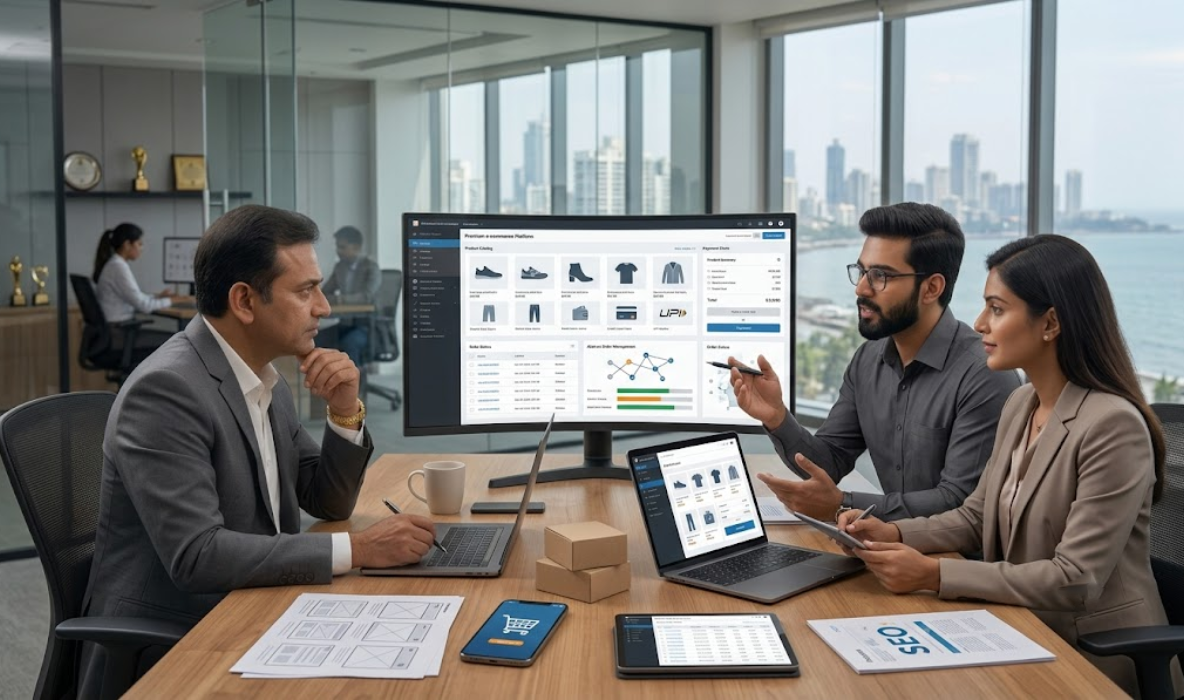

Choosing the right e-commerce website development company in India is an important decision for any business planning to sell products online. A professionally developed online store can help businesses showcase products, manage orders, accept payments, improve customer experiences, and build a stronger digital presence.
However, launching a successful e-commerce website involves much more than displaying product photographs and adding a shopping cart. Businesses must consider website design, mobile responsiveness, payment gateway integration, shipping configuration, inventory management, security, search engine optimization, and long-term scalability.
With many freelancers, agencies, and development companies offering e-commerce services, selecting the right partner can become challenging. Some providers specialize in Shopify stores, while others focus on WooCommerce, custom e-commerce platforms, or enterprise-level online stores.
The best choice depends on your business model, product catalog, budget, technical requirements, and future growth plans.
A reliable e-commerce website development company in India should understand your business goals, recommend suitable technology, provide transparent pricing, and build an online store that customers can navigate and use confidently.
This guide explains how to evaluate development companies, compare proposals, identify essential e-commerce features, understand pricing, and avoid common mistakes when hiring a website development partner in 2026.
1. Understand Your E-commerce Business Requirements
Before contacting an e-commerce website development company in India, define what you want your online store to accomplish.
Different businesses require different e-commerce solutions. A small clothing brand may need product variations, size charts, payment gateways, and shipping integration. A wholesale supplier may require bulk pricing, customer-specific catalogs, quotation requests, and business account management.
Clearly defining your requirements helps development companies recommend the right platform and estimate the project accurately.
Start by identifying your requirements
- What products will you sell online?
- How many products and categories will your store contain?
- Will you sell to individual customers, businesses, or both?
- Will your products require variations such as size, color, or material?
- Which payment methods should customers be able to use?
- Will you ship across India or internationally?
- Do you need inventory or warehouse integration?
- Will customers need accounts and order histories?
- Do you require discounts, coupons, or loyalty programs?
- Will the website connect to accounting, CRM, or marketing software?
Also determine whether you need a new online store or want to redesign an existing one.
A clear requirements document helps an e-commerce website development company in India understand the project’s scope before providing a quotation.
It also reduces the likelihood of discovering essential features only after development has started.
2. Check the Company’s E-commerce Portfolio and Experience
A development company’s portfolio provides useful insight into its design capabilities, technical experience, and understanding of online shopping.
However, simply looking at screenshots is not enough. If possible, visit the live stores the company has developed and explore their actual shopping experience.
Pay attention to how products are organized, how quickly pages load, how easy it is to navigate categories, and whether the checkout process feels straightforward.
What to evaluate in an e-commerce portfolio
- Industry experience: Has the company worked with businesses similar to yours?
- Design quality: Are product pages professional and easy to understand?
- Mobile experience: Does the store work properly on smartphones?
- Navigation: Can customers find products without unnecessary effort?
- Product presentation: Are images, descriptions, variations, and pricing clearly displayed?
- Checkout usability: Is the purchasing process easy to follow?
- Technical functionality: Do filters, carts, and account features work correctly?
- Performance: Do important pages load efficiently?
- Brand consistency: Does each website reflect the client’s identity?
Ask the company to explain its role in each relevant project. A portfolio may include websites where the agency handled only design rather than the complete development process.
An experienced e-commerce website development company in India should be able to discuss its contribution to planning, design, development, testing, and launch.
Look for evidence of sound implementation rather than relying exclusively on promotional claims.
3. Choose the Right E-commerce Platform
The platform you choose affects the store’s design flexibility, management process, integrations, development budget, and long-term maintenance.
A capable development company should explain the available options and recommend a solution based on your requirements instead of automatically promoting one platform for every project.
Questions to ask before selecting a platform
- What are the initial development and recurring costs?
- Can the platform support the expected product catalog?
- Which payment gateways and shipping services are compatible?
- How easily can staff manage products and orders?
- What customization limitations should we expect?
- How will the website scale as the business grows?
- What would be involved in migrating to another platform later?
The best e-commerce website development company in India will explain these trade-offs clearly and help you select technology that fits your business rather than simply choosing the most complicated option.

4. Evaluate Website Design and User Experience
A professional online store should make it easy for customers to discover products, compare options, understand prices, and complete purchases.
An attractive design is valuable, but usability should remain the priority.
When evaluating an e-commerce website development company in India, examine whether the team understands how customers interact with product catalogs, category pages, product details, shopping carts, and checkout screens.
Important design and UX considerations
- Clear product categories and navigation.
- Consistent typography and brand colors.
- High-quality product photography.
- Readable product descriptions and pricing.
- Prominent product availability information.
- Easy-to-use search and filtering.
- Clearly visible add-to-cart buttons.
- Straightforward cart and checkout pages.
- Helpful delivery and return information.
- Mobile-friendly forms and controls.
- Accessible colors, text, and navigation.
- Clear customer support options.
Product pages should provide enough information for customers to make informed purchasing decisions. Depending on the product, this may include specifications, materials, dimensions, size guides, compatibility details, and care instructions.
The checkout experience should avoid unnecessary steps and confusing form fields.
Ask prospective developers how they approach usability testing and how they handle feedback before launch.
A well-designed e-commerce website should reflect your brand while making shopping straightforward across common devices.
5. Confirm Mobile Responsiveness and Website Performance
Many customers browse and shop using smartphones. An online store that works well only on desktop computers can create unnecessary friction and missed sales opportunities.
Mobile responsiveness should therefore be a core requirement when hiring an e-commerce website development company in India.
The development team should test how the store behaves across different screen sizes rather than relying exclusively on a desktop preview.
Mobile and performance checklist
- Test product pages on smartphones and tablets.
- Confirm that menus and category navigation work properly.
- Ensure product images resize correctly.
- Make buttons large enough to use comfortably.
- Test product variations and quantity selectors.
- Check cart and checkout usability.
- Optimize large images.
- Minimize unnecessary scripts and plugins.
- Configure suitable caching where supported.
- Test important pages using performance tools.
- Review Core Web Vitals.
- Check for layout shifts and slow-loading elements.
Performance depends on several factors, including hosting, theme quality, image sizes, scripts, integrations, and the way the website has been developed.
Ask the provider how it will test performance and prioritize improvements.
A high performance score does not guarantee search rankings or sales, but a responsive, reliable shopping experience helps customers use the website more comfortably.
6. Check Payment Gateway and Checkout Integration Experience
Payment integration is one of the most important technical requirements for an online store.
Customers should be able to understand the available payment methods, enter the required information securely, and receive clear confirmation after completing an order.
An e-commerce website development company in India should have experience configuring payment gateways appropriate for your target market and business model.
Payment and checkout features to discuss
- UPI payments, where supported.
- Debit and credit card payments.
- Net banking and supported digital wallets.
- Cash on delivery, where appropriate.
- Payment success and failure handling.
- Order confirmation emails or messages.
- Refund and cancellation workflows.
- Transaction status tracking.
- Secure payment processing.
- Appropriate tax and billing configuration.
Payment availability, eligibility, settlement terms, and transaction charges vary by provider and business category.
Ask the developer which gateway they recommend and whether the integration cost is included in the proposal.
The business should also understand any separate payment provider fees.
Before launch, test the entire purchasing journey using the payment provider’s supported test environment where available. Confirm that failed payments do not incorrectly mark orders as paid and that successful transactions generate the appropriate order records and notifications.
A reliable checkout process helps reduce avoidable customer confusion and operational problems.
7. Verify Shipping, Inventory and Order Management Capabilities
An online store must do more than accept orders. It should also help the business manage stock, shipping, order status, cancellations, and customer communications.
These operational requirements can become more complicated as the product catalog and order volume grow.
A development company should understand how your business processes orders before recommending integrations or custom functionality.
Essential operational features
- Product stock tracking.
- SKU and product variation management.
- Shipping zones and delivery rules.
- Shipping charges and free-shipping thresholds.
- Courier or logistics integrations where required.
- Order status management.
- Automated order notifications.
- Invoice generation where required.
- Cancellation and refund workflows.
- Low-stock notifications.
- Returns and exchange processes.
- Inventory synchronization across channels, if needed.
For example, a store selling apparel may need size and color variations, while a business selling bulky products may need weight-based shipping rules.
If you sell through multiple marketplaces or physical stores, you may also need inventory synchronization to prevent stock discrepancies.
Ask the e-commerce website development company in India whether these features will use established integrations or require custom development.
Clarify who will configure shipping rates, upload product data, and test the order workflow.
The right setup should reflect your real operational process rather than forcing your team to work around an unsuitable system.

8. Review E-commerce SEO and Product Page Optimization
Search engine optimization helps search engines understand your website and can improve the chances of relevant product and category pages appearing in search results.
However, e-commerce SEO requires more than installing an SEO plugin or writing a meta description.
Your development company should understand how website architecture, product information, internal links, performance, and technical settings work together.
E-commerce SEO checklist
- Create clear category and subcategory structures.
- Use descriptive product URLs.
- Write unique product titles and descriptions.
- Optimize page titles and meta descriptions.
- Use logical heading structures.
- Add descriptive image alternative text.
- Implement relevant internal links.
- Configure canonical URLs appropriately.
- Generate and maintain an XML sitemap.
- Review robots.txt and indexing settings.
- Handle unavailable and discontinued products carefully.
- Add appropriate structured data where supported.
- Connect Google Search Console.
- Optimize important landing pages for mobile devices.
Product structured data can help search engines understand details such as product information, pricing, availability, and reviews when the relevant properties are implemented correctly.
Search visibility depends on relevance, content quality, competition, technical implementation, and other factors. No development company can legitimately guarantee a specific Google ranking.
Before signing a contract, ask whether SEO setup is included, what tasks it covers, and whether ongoing keyword research or content optimization requires a separate budget.
9. Understand E-commerce Website Development Pricing
E-commerce website development prices vary widely because projects can range from a simple product catalog to a sophisticated online retail platform with custom integrations.
Ask what the quotation includes
- Website design and development.
- Number of page templates.
- Product upload and catalog setup.
- Payment gateway integration.
- Shipping configuration.
- Basic SEO implementation.
- Mobile responsiveness.
- Security configuration.
- Analytics setup.
- Testing and launch support.
- Training for store management.
- Post-launch support period.
Also ask about domain registration, hosting, premium theme or plugin licenses, payment processing charges, and ongoing maintenance.
A lower quote may be suitable for a straightforward store, but it may not include custom features or extensive product data entry.
Comparing the scope of work is more useful than comparing headline prices alone.
10. Evaluate Website Security, Privacy and Compliance
An e-commerce website handles important business and customer information, making security an essential part of the development process.
The appropriate security measures depend on the platform, the information collected, payment integrations, hosting environment, and operational requirements.
A professional e-commerce website development company in India should explain how security will be configured and maintained after launch.
Security considerations
- Enable HTTPS across the website.
- Use strong administrator credentials.
- Enable multi-factor authentication where available.
- Restrict access according to staff responsibilities.
- Keep the platform, themes, and plugins updated.
- Configure reliable backups and restoration procedures.
- Use reputable payment gateways.
- Avoid storing sensitive payment information unnecessarily.
- Protect enquiry and account forms against abuse.
- Remove unused software and accounts.
- Monitor security issues and apply relevant updates.
- Establish a process for handling incidents.
Businesses should also review the privacy information displayed on the website and identify which customer details are collected, why they are collected, and how they are handled.
Depending on the business and its activities, applicable privacy, consumer-protection, tax, and e-commerce requirements may need specialist review.
Do not assume that an SSL certificate alone makes an online store completely secure.
Clarify which security measures are included in the initial project and which require ongoing maintenance or third-party services.
11. Check Communication, Project Management and Post-Launch Support
A successful e-commerce project depends on collaboration between the business and the development team.
Even a technically capable provider can create difficulties if project expectations, responsibilities, deadlines, and approval processes are unclear.
Before hiring an e-commerce website development company in India, understand how it manages the project from planning to launch.
Questions to ask the company
- Who will manage my project?
- How often will progress updates be provided?
- What is the estimated development timeline?
- How many design revisions are included?
- What materials must I provide?
- How will additional requirements be priced?
- Who will test the website before launch?
- Will my team receive store-management training?
- What support is included after publication?
- How are urgent technical issues handled?
- Will I receive full administrator access?
- What happens if I want to move to another provider?
Request a written agreement covering project scope, payment milestones, responsibilities, delivery expectations, and post-launch support.
Make sure your business retains appropriate access to its domain, hosting, payment accounts, analytics, and website administration.
Also confirm whether maintenance includes updates and backups only or whether it covers content changes, new features, and technical troubleshooting.
Clear communication and ownership arrangements help protect your investment and make future website improvements easier.
Conclusion
Choosing the right e-commerce website development company in India requires careful evaluation of technical expertise, design quality, platform knowledge, pricing transparency, communication, and ongoing support.
The right provider should understand your products, customers, order management process, payment requirements, and growth plans before recommending a solution.
Review live portfolio examples, compare itemized proposals, and confirm that the website will provide a responsive shopping experience, secure checkout, reliable inventory management, and a suitable SEO foundation.
Do not focus exclusively on the initial development price. Consider recurring platform costs, hosting, software licenses, payment fees, maintenance, and future improvements when planning your investment.
A well-developed e-commerce website can provide the foundation for online sales and long-term digital growth. By following the evaluation steps in this guide, your business can make a more informed decision and choose a development partner that fits its needs in 2026.

